Debug wrapper for any problem. More...
#include <DebugProblem.hpp>
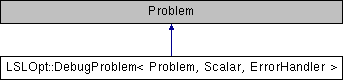
Inheritance diagram for LSLOpt::DebugProblem< Problem, Scalar, ErrorHandler >:
Public Member Functions | |
| template<typename ... Args> | |
| DebugProblem (ErrorHandler &error_handler, Args &&... args) | |
| Construct a new debug problem. More... | |
| void | setDerivativeEpsilon (const Scalar &derivative_epsilon=1e-6) |
| Set the epsilon value for numerical derivative calculation. More... | |
| void | setCompareEpsilon (const Scalar &compare_epsilon=1e-3) |
| Set the epsilon value for comparison of analytical and numerical derivative. More... | |
| const Scalar & | getDerivativeEpsilon () const |
| Get the epsilon value for numerical derivative calculation. | |
| const Scalar & | getCompareEpsilon () const |
| Get the epsilon value for comparison of analytical and numerical derivative. | |
| Implementation::problem_traits< Problem, Scalar >::gradient_type | gradient (const Vector< Scalar > &x) |
| Calculate and check the gradient. More... | |
Detailed Description
template<typename Problem, typename Scalar, typename ErrorHandler>
struct LSLOpt::DebugProblem< Problem, Scalar, ErrorHandler >
Debug wrapper for any problem.
This wrapper class compares the provided gradient function to the numerically determined gradient by finite differences.
- Warning
- This makes the optimization slow and is not intended for production use.
Constructor & Destructor Documentation
◆ DebugProblem()
template<typename Problem , typename Scalar , typename ErrorHandler >
template<typename ... Args>
|
inline |
Construct a new debug problem.
- Parameters
-
error_handler Functor that is called in case of errors. args Arguments are passed through to the constructor call of the problem.
- Note
- The epsilon values may have to be adapted for your problem.
Member Function Documentation
◆ gradient()
template<typename Problem , typename Scalar , typename ErrorHandler >
|
inline |
Calculate and check the gradient.
- Parameters
-
x Point where to evaluate the function.
- Returns
- Gradient at x.
This function checks the calculated gradient against the numerically determined gradient using the finite difference method.
If the deviation is too large, the error functor is called.
◆ setCompareEpsilon()
template<typename Problem , typename Scalar , typename ErrorHandler >
|
inline |
Set the epsilon value for comparison of analytical and numerical derivative.
- Parameters
-
compare_epsilon Epsilon for comparison of analytical and numerical derivative.
- Note
- Meaningful values depend on the problem at hand!
◆ setDerivativeEpsilon()
template<typename Problem , typename Scalar , typename ErrorHandler >
|
inline |
Set the epsilon value for numerical derivative calculation.
- Parameters
-
derivative_epsilon Epsilon for numerical derivative calculation.
- Note
- Meaningful values depend on the problem at hand!
The documentation for this struct was generated from the following file:
- include/LSLOpt/DebugProblem.hpp